Foundation engineering in Corona, California, encompasses the critical analysis, design, and planning of structural support systems that transfer building loads safely to the ground. This discipline is paramount locally because the region's complex geology demands tailored solutions far beyond standard construction practices. A comprehensive foundations category covers everything from initial subsurface investigation to the final selection of appropriate systems, including shallow foundation design for stable, low-load scenarios and pile foundation design for deep, competent strata. The overarching goal is to mitigate settlement, prevent bearing capacity failure, and ensure long-term structural integrity against the unique challenges posed by Southern California's dynamic landscape.
The local geology of Corona is a primary driver for sophisticated foundation engineering. The city sits within the northern Peninsular Ranges, characterized by a mix of ancient granitic and metamorphic bedrock, dissected by alluvial fans and washes from the Santa Ana River and its tributaries. This creates a highly variable subsurface where competent rock can be shallow in the foothills but masked by deep, compressible alluvium on the valley floor. Critically, the presence of expansive soils, rich in smectite clays, is widespread across western Riverside County and poses a significant risk. These soils undergo substantial volume changes with moisture fluctuation, capable of heaving and cracking lightly loaded structures, a primary concern addressed through specialized expansive soil evaluation.
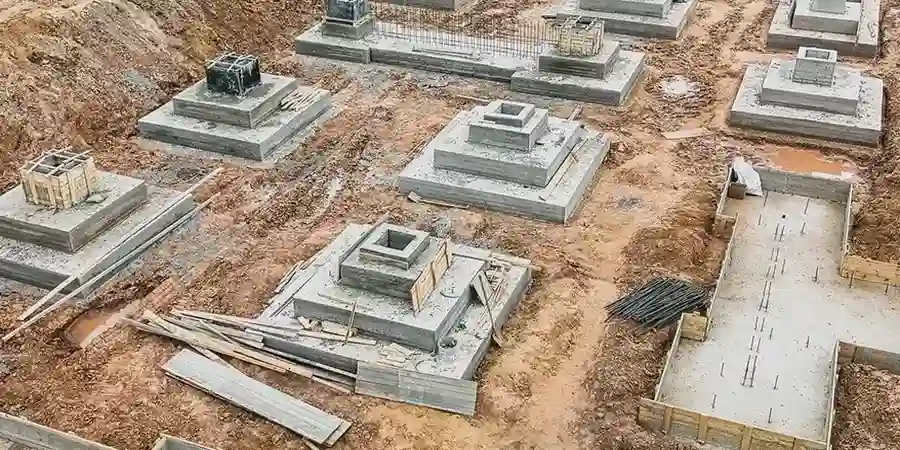
All foundation work in Corona is governed by the stringent requirements of the California Building Code (CBC), which adopts and amends the International Building Code (IBC). Chapter 18 of the CBC specifically regulates soils and foundations, mandating thorough geotechnical investigations for almost all new construction. The code enforces specific parameters for bearing capacity analysis, lateral earth pressures, and settlement tolerances. Furthermore, given Corona's location in a seismically active zone, seismic design provisions per CBC Chapter 16 and ASCE 7 are non-negotiable, requiring foundations to resist not just vertical loads but also lateral shaking and potential soil liquefaction in saturated granular deposits. Compliance with local city ordinances and Riverside County grading permits adds another layer of regulatory oversight.
This full spectrum of foundation services is required across a diverse range of projects in Corona. Residential developments, from single-family homes in master-planned communities to custom estates in the hills, routinely demand evaluations for expansive soils and often utilize post-tensioned slabs or raised floors. Commercial and industrial buildings, including the vast logistics centers along the I-15 corridor, frequently require deep foundation systems like driven piles or drilled piers to support heavy column loads on poor near-surface soils. Infrastructure projects, such as bridges and retaining walls, rely on advanced analyses for fills and slopes, making foundations on fill a critical service. Seismic retrofits of existing structures also form a key part of the local engineering practice.
Available services
Quick answers
Why is a site-specific geotechnical investigation mandatory for foundations in Corona, California?
A site-specific investigation, required by the California Building Code (CBC), is mandatory because Corona's geology varies dramatically over short distances. You can find hard granitic bedrock, deep compressible alluvium, or expansive clay on a single lot. This investigation determines the precise soil profile, groundwater depth, and engineering properties needed to design a safe, code-compliant foundation and avoid costly failures from settlement or heave.
What is the difference between a shallow and a deep foundation, and how do I know which is right for my Corona project?
Shallow foundations, like isolated footings or mat slabs, transfer loads to near-surface soils and are suitable when competent ground is within a few feet of grade. Deep foundations, such as driven piles or micropiles, bypass weak upper strata to bear on rock or dense soil. The right choice depends entirely on the results of a bearing capacity analysis, the project's load requirements, and the site's specific subsurface conditions as detailed in the geotechnical report.
How do expansive soils affect building foundations in Corona, and what is the typical solution?
Expansive soils, common in Corona, swell when wet and shrink when dry, exerting significant uplift pressure that can crack slabs and distort framing. The standard solution involves a thorough expansive soil evaluation to quantify the risk, followed by a design that isolates the structure from these movements. This often means using a structurally reinforced post-tensioned slab, or a raised structural floor supported on drilled piers that extend below the active zone of moisture fluctuation.
What role does seismic design play in the foundation engineering process for a new building in Corona?
Given Corona's proximity to major faults like the San Andreas and Elsinore, seismic design is integral to the process. Foundation engineers must design for lateral shaking and potential soil liquefaction as mandated by CBC Chapter 16. This involves connecting structural elements to resist overturning, designing deep foundations to withstand lateral loads, and sometimes performing ground improvement to mitigate liquefaction risk in loose, saturated sandy soils.